Consulting on social robots
Social robots greet guests, provide information and accompany people in everyday life. BIST gives you vendor-independent advice on which robot suits your use in care, at reception or at events, guides its introduction and adapts its applications to the way you work.
What are social robots?
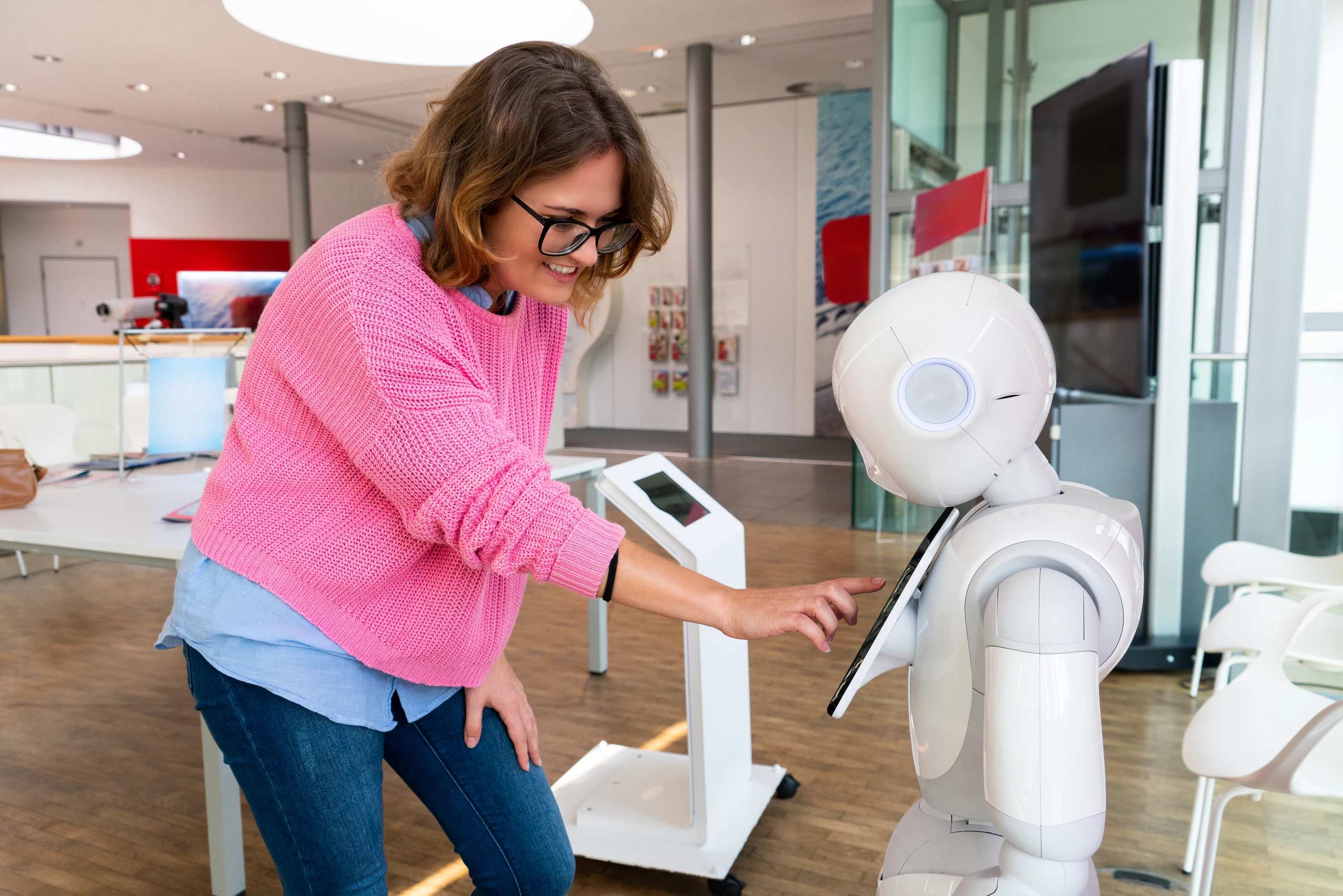
Social robots are robots that engage with people through speech, facial expressions and gestures while following social conventions. Unlike service robots, which clean or transport, their task lies in conversation: they greet, inform, remind and entertain. They come as small tabletop robots, with a human-like face or as mobile companions.
Services
Choosing the right robot
The robot that fits the task, the surroundings and the audience.
- Clarifying the task: greet, inform, activate or entertain
- Requirements for language, mobility, operation, camera and microphone
- Comparison of suitable models on the market
- A vendor-independent recommendation
Guiding the introduction
An introduction aimed at people accepting the robot.
- Planning where the robot stands, when it speaks and who looks after it
- Preparing your staff and answering their questions
- Setup on site, from the Wi-Fi to the volume
- Support in the first period of operation, with adjustments
Applications for the robot
Applications that let the robot know your routines and speak in your tone.
- Extensions through the manufacturer's programming interfaces
- Existing applications adapted to your use
- New applications: greetings, information about your organisation, conversation flows for events
Typical starting points and our answer
You want to greet and inform guests and customers at reception without someone having to be available all the time.
We discuss with you what the robot should do at reception and compare suitable models on the market. Our recommendation is vendor-independent.
Choosing the right robotIn care, support or assistance for people with disabilities, you are looking for an addition that activates and entertains without replacing human attention.
We plan with your team when and where the robot is used and who looks after it, and prepare your staff for it. That way it adds to the work of skilled staff instead of replacing it.
Guiding the introductionAt a trade fair, at an event or in a publicly accessible space such as a foyer, an exhibition or a waiting area, a robot should approach people, answer their questions and point them to what is on offer.
We connect the robot to an AI assistant that answers questions about what you offer or about your event from your own documents.
Knowledge bases and AI assistants (AI solutions)You have already bought a robot that is hardly used and want to find out how it can do meaningful work in your everyday routine.
We check where the robot can help in your daily routine, adapt its existing applications to your use or program new ones.
Applications for the robot
Experience from research
Both founders of BIST research social robots at the University of Hildesheim, including the question of when people perceive AI systems and robots as human-like. Paul-Ferdinand Steuck is doing his PhD on the anthropomorphism of generative AI and social robots. The founders publish their findings in the academic literature, most recently in the article „Einsatz von Sozialrobotern mit KI-Agenten in Wohnquartieren“ (social robots with AI agents in residential neighbourhoods, HMD, 2026), which is based on a Delphi study with 43 experts. For your project, this means advice that translates the state of research into practical use. It is guided not by the technology alone, but by how a robot affects the people who encounter it.
All researchWhy BIST
Research meets practice
We know new AI concepts from research before they reach finished products.
Data protection from the start
As TÜV-certified data protection officers, we plan every solution so that your data stays protected.
Consulting and implementation from a single source
We support you from the first conversation through to operation.
Vendor-independent
We are not tied to any vendor and recommend what suits your task.
Two dedicated contacts
Both founders know your project. You always speak to someone who builds it.
Talks
How people respond to robots and where social robots already help today.
- Social robots at work
- When people meet robots
- Finding the right robot
Frequently asked questions
What can a social robot do, and what can it not do?
A social robot can greet people, answer questions, give reminders, encourage movement and conversation, and entertain. It does not replace skilled staff or human attention. How well it fulfils its task depends heavily on the surroundings, the applications and the way it is introduced. That is why we clarify what is realistic for your use before making any recommendation.
Do you sell robots?
No. BIST does not sell robots and is not tied to any manufacturer. We advise on the choice, guide the introduction and program applications. You buy the robot from the manufacturer or dealer of your choice. This keeps our recommendation independent of whichever model you eventually purchase.
How much does advice on social robots cost?
The cost depends on whether we advise on the choice, guide the introduction or program applications for the robot, and on how many sites it is used at. The robot itself is not included; you buy it from the manufacturer or a dealer. BIST Consulting works as a project with an agreed scope and price or with a monthly budget of hours. The intro call is free of charge.
How do people react to a social robot?
That depends on the place, the audience and the introduction. Curiosity is common, and so is reserve. From research we know that appearance, speech and placement in the room strongly influence whether people accept a robot as a counterpart. We take these factors into account when choosing and introducing a robot.
What does a robot with a camera and microphone mean for data protection?
Many social robots process images and speech, sometimes via their manufacturer's services. As TÜV-certified data protection officers, we check during selection which data a model collects, where it is processed and how this can be restricted.
Which organisations is a social robot suitable for?
Typical settings are reception areas of companies and public authorities, care, support and disability assistance facilities, community spaces in residential neighbourhoods, and trade fairs and events. What matters is less the sector than the task: a robot is suitable when it takes over recurring conversations or activates people without tying up staff all the time.
Let’s talk about your project
Before we write a proposal, we take the time to understand your company and your requirements. The intro call is free of charge.
Book an intro call